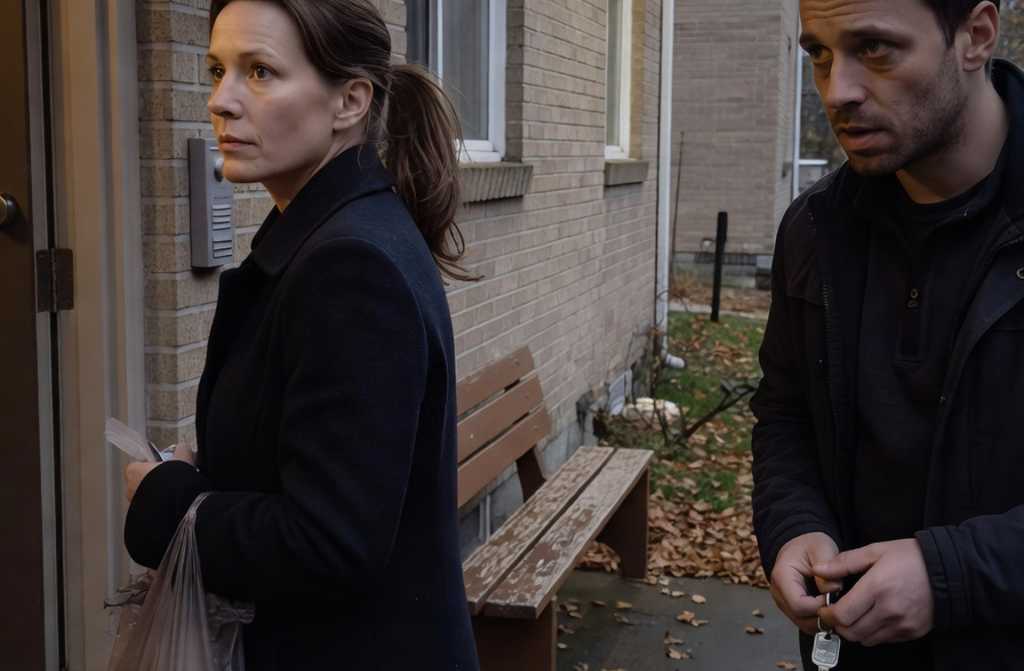
It was many years ago now, but Emma could still vividly remember standing outside the entrance of her new flat. A typical brick apartment building in a suburban district, nothing remarkable among the many similar ones. She had just come back from work, the bag of groceries weighing comfortably on her arm, evoking thoughts of the simple home comforts she had been striving for lately.
The evening was cool. Emma shivered, pulling her coat tighter around her. A light breeze toyed with strands of her hair that had escaped from her casual ponytail, and a faint blush played on her cheeks from the chill. She was already reaching for the intercom when she noticed Andrew.
He stood a few paces away, as though unsure whether to come closer. His hands nervously gripped the car keys, the very silver keyring she had once selected for his birthday. His stance betrayed deep unease: shoulders rigid, fingers constantly fiddling with the keys, and his eyes darting anxiously across her face, as if seeking answers before she could voice them.
“Emma, please hear me out,” Andrews voice came out unusually gentle, almost hesitant. He edged forward a little but then halted, seeming afraid to disturb her. “Ive gone over everything. Lets give it another try. I I was mistaken.”
Emma let out a slow breath. She had heard these words before, across various stages of their time together and in different situations, yet the result had always been the same. Elegant phrases were always followed by familiar patterns, earlier missteps, fresh wounds. She regarded him steadily, without any sign of agitation:
“Andrew, weve covered this already. Im not returning.”
He moved nearer, almost touching her. Desperate hope shone in his eyes, as if he genuinely believed that this moment, this time, would alter her choice.
“But look how things have turned out!” his voice wavered. “Without you its all coming apart. I cant manage!”
Emma watched him in silence. The street lamp cast a soft glow on his face, and she saw with fresh clarity the shifts that had taken place over the past six months. Lines had deepened around his eyes, ones she had overlooked before. His stubble, once neatly kept, now appeared rough, as though he had neglected his appearance for some time. And in his eyes lay a weariness she had not witnessed across all fifteen years of their shared life.
Andrew took one more step forward, nearly crowding her space. A pleading tone entered his voice:
“Lets begin again. Ill purchase a flat. The one you wanted. And a car, the kind you dreamed about. Just come back”
For an instant Emma felt something shift within her. His tone held such genuineness, his eyes burned with such real wish to set things right, that for a brief second she almost believed. Yet the feeling faded quickly. She mentally reviewed the string of earlier vows, grand and appealing yet never more than words. How often had he promised to alter himself, how often sworn to start fresh And each time matters reverted to their old ways.
“No, Andrew,” the woman replied firmly. “Ive settled on this. And I have no plans to reverse it. You sent me away yourself, you treated me as nothing Ill never forgive you.”
Emma sighed quietly and gently placed the bag of groceries on the wooden bench near the entrance. The evening air grew cooler still, and she drew her coat closer once more.
“You truly dont see it, Andrew?” her voice stayed calm, free of annoyance, yet carried firmness. “Its not the flat or the car.”
Andrew started to speak in reply, but Emma softly lifted her hand to halt him. He paused, swallowed hard, and nodded without a word, showing he was prepared to listen.
“Recall how it all started?” her look turned distant, as though she gazed not at him but far off into the past. Her eyes narrowed slightly, seeming to peer through the haze of time at days long gone.
She paused a moment to gather herself, then went on:
“We were young and in love. You worked for a building firm, and I had only just begun as a primary school teacher. We rented a flat, small and cramped, yet we were content. Money was always tight, at times we even counted every penny until payday, but we kept our spirits up. We prepared meals together, laughed over our setbacks, made plans ahead. We hoped for children, pictured strolling with a pram through the park, how the whole family would head out together for the start of the school year”
Andrew nodded in silence. He truly recalled that time, one of the brightest stretches in his life. Back then anything had seemed within reach. Every difficulty appeared not as a disaster but merely a passing hurdle they could surmount side by side. He thought back to their first rented flat, the tiny kitchen, the squeaky sofa, the tap that leaked without end and which they never managed to repair before leaving. He remembered sitting on the floor, eating pizza straight from the box while sketching out a future they believed would surely come to pass.
“Then the girls arrived,” Emmas voice grew warmer, though a trace of sadness now threaded through it. “Lily first, and five years on, Sophie. You were overjoyed, so proud of them both. I remember you cradling Lily in the hospital, so moved and full of happiness. And when Sophie came, you brought a massive bunch of roses and a cake, even though the doctors had been clear about avoiding sweets”
She smiled, yet the smile held sadness, as though the memory of those days both comforted and stung at once.
“And then something shifted,” she continued, her voice turning firm again. “You began to earn more, bought this large flat in a new development, a car Everything turned different. You became the head of the household, the provider, a man who had made it. And I I became merely the wife who does nothing. Recall how you once remarked: You stay at home while I run around like a hamster on a wheel? You never noticed that behind this staying at home were sleepless nights tending sick children, parents evenings, after-school clubs, tutors, washing, tidying, cooking All the things that, in your view, did not amount to real work.”
Emma stopped, her eyes on Andrew. No anger showed there, only weariness and a quiet sorrow from someone who had spent years trying to convey something vital yet had never been truly listened to.
Andrew began to reply, words already forming to defend his choices. But Emma stopped him once more with a single motion of her hand. Her gaze remained steady, yet determination lay behind it; today she would not be cut short midway.
“Please dont interrupt,” she said again, raising her voice slightly to ensure he heard. “I stayed quiet for a long time and put up with it. You often claimed I was forever unhappy, that I created rows over nothing. But do you know why it came to that? Because I was attempting to reach you. I was trying to show that the girls needed more than a fresh toy or a trip to the coast; they needed attention, discipline, limits. That love means not only granting wishes but also knowing when to say no if it matters.”
She allowed a brief pause, giving him space to take in the words, then resumed, speaking a touch more slowly:
“You always let them have their way. Recall how Lily, when she was still tiny, would dash up to you with tear-filled eyes: Daddy, I want a new tablet! and within an hour it sat in her hands? Or how Sophie, a bit older, would announce: Daddy, I dont want to do my homework! and you would let her leave it until the next day because the child is worn out, she needs rest?”
Andrew dropped his head without meaning to. Those moments rose at once in his mind, sharp as if they had happened yesterday. He recalled the girls wrapping their arms around his neck and whispering, “Youre the best daddy!”, their eyes bright with delight at each new purchase. In those times it had seemed to him he was doing right, offering the children joy to make up for his long hours away at work. Emma would frown then, mention something about proper raising and the consequences, but he would wave it away: “Let them enjoy life while theyre young! Plenty of troubles will come soon enough.”
“And when I tried to guide them,” Emmas voice softened but kept its resolve, “you would shout that I was picking on the children, that I was cruel. Remember how you forbade me to raise my voice to them? You said it would harm their minds, that I ought to be a kind mother instead of a taskmaster.”
She shook her head, and the gesture spoke not of anger but of deep tiredness from a person who had attempted many times to explain the same point yet had never been heard.
“And this is what came of it,” she went on, meeting his eyes directly. “At eight and thirteen they cannot tidy after themselves, they have no grasp of no, they value nothing because they receive whatever they demand at once. They do not understand that belongings must be looked after, that time is precious, that actions carry consequences. And whenever I try to bring in some order, they run to you: Dad, Mums cross again! and you step in straight away, telling them Im in the wrong.”
Emma fell quiet, letting him absorb what she had said. A heavy stillness settled, broken only by the far-off sound of cars passing and the odd bark of a dog somewhere in the yard. She did not expect an instant reply; she simply wanted him to grasp at last that her endless complaints had not been whims but a desperate bid to hold together the balance in the family, a balance he had slowly undone without noticing.
Andrew opened his mouth to argue, yet the words seemed to lodge in his throat. He wished to claim it had not been so, that Emma overstated matters, that her reading of events was too rigid. But as he began to sort through his points in his mind, he suddenly saw that, at heart, she spoke the truth. Not every detail, perhaps, not completely, but the core of it, that he truly had behaved that way, thought that way, spoken that way.
“And then this Rachel of yours came along,” Emma continued, her voice level and almost detached, as though recounting a tale that belonged to someone else. “Young, attractive, no children, no troubles. She gazed at you with admiration, agreed with every word, never argued. She smiled always, never brought up daily chores, never asked for help with school books or noted that the fridge was nearly bare.”
She allowed a short pause, as if inviting him to consider each point, then carried on:
“And you decided this was happiness. That you had at last found someone who understands you. You came to me that evening once the girls were asleep. You spoke coldly, as if addressing an employee: Emma, I cannot go on. You are always unhappy. You do nothing but shout, you give me too little attention. I have met someone who understands me. Who is glad simply that I am here.”
Andrew recalled that exchange down to the smallest detail. At the time he had felt almost heroic, a man who had finally taken a brave step and shed the weight of an ungrateful family life. The thought had turned in his head: “I have earned the right to be happy.” He had even felt proud of his resolve, that he could state his grievances plainly and had not yielded to any possible pleas. It had seemed to him he was acting sensibly, fairly, in a grown-up manner.
“You said you wanted a divorce,” Emmas voice caught for a moment, but she steadied herself at once, clenching her hands into fists to keep her feelings hidden. “And you added that the girls would remain with me. You stated it outright: They will do better with you. And I will finally be able to live as I wish.”
She paused for a second, as though living that moment afresh, then added:
“You pictured meeting Rachel, travelling, dining out, looking after yourself. You even worked out how much you would pay in child support if the court awarded the children to me. You had every detail planned ahead, the costs, the schedule of visits, any possible deals. As though it concerned a business arrangement at work rather than our family.”
A quiet, weary bitterness coloured her tone, the kind from someone who had long tried to keep something that could no longer be saved. She did not charge him with betrayal, did not raise her voice or hurl accusations; she simply laid out the facts he himself had once stated, without pausing to consider how they might sound to another.
Andrew swallowed, feeling a dry lump form in his throat. Yes, he truly had thought that way back then. At that moment divorce had seemed to him not a hard choice but rather a way of escape, a kind of pass into a fresh, untroubled life. In his minds eye he had seen a picture of no more daily cares, no reproaches, no endless childish fusses or household tasks. Only liberty, ease, the chance to pursue what pleased him, to spend time with Rachel, to shape a relationship free of the weight of what had gone before.
“I agreed to the divorce,” Emma went on in a calm, steady voice, as though describing something distant that no longer stirred strong feelings. “Not because I had surrendered, and not because I had ceased to fight. It was simply that at a certain point I saw clearly: you had stopped being with me long before. You lived your life, and I lived mine. We had drifted into separate worlds where our paths no longer met.”
She took a brief pause to choose her words, then added:
“And so I said the girls would stay with you.”
Andrew gave an involuntary start, recalling that talk. In that instant he had been struck speechless. He had expected an entirely different outcome: freedom from family duties, a fresh beginning, a life lived exactly as he pleased. And her suggestion had overturned everything.
“You were shocked,” Emma continued, holding his gaze. “You shouted that it was unjust, that I was trapping you, that I could not act that way. You could not understand why I insisted. But I simply wanted you to see at last: children are not hindrances in life, not a load, but part of it. And if you chose to start over, then you had to learn to carry responsibility for those you had brought into the world.”
He remembered that day in court clearly. Everything had unfolded as if through mist: the judges stern face, the dry phrases in the papers, the clerks flat voice. Andrew had been wholly certain the ruling would favour him. He had already planned in his mind how he would launch a new life, how he would see Rachel, travel, tend to himself. No doubts had occupied his thoughts, only a firm belief that the court would release him from unneeded duties.
Then the judge read out the decision. The words came sharp and cold: custody of the children went to the father. For the first few seconds Andrew did not even grasp what had occurred. He had awaited joy, relief, yet instead felt everything inside him contract. In place of the freedom he had longed for, he had suddenly been given two small burdens that now rested fully on him.
He recalled how that same evening he had been left alone with the girls for the first time. The flat had seemed oddly loud, belongings lay out of place, and supper had to be warmed from packets. It was then that it first struck him: he could no longer simply leave for work and return whenever he chose, ignoring the small daily matters. All of it had become his duty.
Emma paused to let him take in what she had said.
“And then you grasped what it meant to raise two spoiled girls without their mothers help,” Emma said softly, without any hint of satisfaction. “You finally saw what your way of bringing them up had produced. The girls would not listen to you, acted as they always had Yet there was no one left to shift the difficulties onto.”
She allowed another short pause, as though letting him return in thought to those days, then resumed:
“Recall how you tried to make dinner, yet everything burned because you kept answering work calls? How the washing-up stayed undone because neither you nor the girls found time for it? And one night you rang me in a panic because Sophie had thrown a fit over you not buying her new trainers like everyone else. You had no idea what to do or how to soothe her, so you ended up calling my number”
Andrew closed his eyes. All those moments rushed past him like scenes from a poor film he could not pause. He saw himself clearly standing in the kitchen with a scorched pan while Lily laughed and filmed it on her phone. He saw Sophie slamming her bedroom door and yelling that he “understood nothing”, while he stood in the hallway unsure how to act.
He had attempted to introduce rules, banning screens until homework was finished, setting a timetable for chores, limiting pocket money. But within a day he had yielded to tears and shouts: Lily wept that he was “harsh”, Sophie threatened to go to her grandmothers. He could not bear those scenes and gave way again.
And there had been Rachel. At first she had acted friendly, smiling at the girls, suggesting outings to the park, buying them treats. But the moment Lily spilled juice on her new dress by accident or Sophie misbehaved in a restaurant, everything altered. Rachel would step back, frown at toys left about, sigh with irritation when Sophie sought attention. “I am not prepared to look after other peoples children,” she had said once, and that marked only the start.
“Rachel left after three months,” Andrew said quietly, eyes still shut. The words came with difficulty, as though he confessed to something shameful. “She said she was not ready for it. That it was not her story, that she wanted another kind of life, an easy one without cares or duties.”
He fell silent to collect himself, then added:
“And I I suddenly saw that without you everything collapses. The girls pay no heed to me, the house stays in constant disorder, work brings stress because I am short of sleep and distracted by their troubles. I had believed I would be free, that I could at last live exactly as I wished. Instead I found myself trapped, in a home where everything demands notice, where each day brings dozens of small questions I have no answers for.”
His voice shook, but he regained control quickly. There was no pretence or bid for sympathy in this admission, only a bitter recognition of how greatly he had erred in supposing family life was merely a weight one could shed without cost.
Emma regarded him with understanding but no pity. Her look held neither victory nor any wish to wound, only a calm grasp of all they had both endured.
“You know what strikes me as oddest?” she smiled faintly, and the smile carried no bitterness or mockery, merely a gentle irony at the turns life takes. “When I found myself alone, I could finally breathe. Truly breathe, without that constant sense that an overwhelming load rested on my shoulders.”
She paused for a second, as though reliving those first weeks of life on her own, then went on:
“I took a new job, now I am a senior curriculum advisor at an education centre. Not merely a primary teacher, but someone who shapes programmes, supports other educators, joins in worthwhile projects. And do you know? I enjoy it. I feel I am progressing, that my knowledge and experience truly matter. The pay, as it happens, is better than before, enough not just for necessities but for small treats as well.”
Emma let her eyes move over the yard where they stood, as though seeing beyond the plain brick buildings and the playground to the image of her new life.
“I rent this flat, and it suits me well. There is enough for everything: food, clothes, cinema trips at weekends. For a manicure once a month, for a book I have wanted to read, for coffee in a pleasant cafe close by. I no longer hurry from work to the shops to fetch groceries for the next evenings meal. I do not prepare those endless three courses, starter, main and dessert, as though I ran a restaurant from home. I do not tidy up after grown people who behaved like cheeky members of the family and believed household tasks were solely my concern.”
Her voice stayed even, without defiance, simply noting facts that had once seemed to her impossible to overcome.
“And one more thing that matters: I sleep through the nights. I truly sleep, instead of waking because someone plays music until three or suddenly starts homework at midnight. I am living, Andrew. Simply living, calmly and steadily, without constant strain and the feeling that I owe something to everyone.”
She met his eyes directly and openly, without resentment or reproach. Her words showed no wish to boast or claim superiority, only a quiet knowledge that, despite every difficulty, she had found her own way and felt truly content.
Andrew remained silent. His thoughts felt strangely empty, without prepared replies, excuses or usual defences. He suddenly grasped with startling clearness that everything he had so fiercely wanted, freedom, ease, admiration from a new partner, had proved an illusion, a trick of the light. Real life, as it turned out, had been there, in their old flat. In those very small things he had grown used to seeing as burdens: in her complaints about socks left scattered, in endless patience, in quiet care that he had wrongly read as discontent and fault-finding.
He recalled how she would make coffee for him in the mornings even when she herself ran late for work. How she would clear the dirty plates without a word, though he had promised to wash them. How she always found the right words for the girls when he felt lost and angry. All of it had seemed to him ordinary, everyday, and now he saw plainly: this had been love. That real, true love which does not proclaim itself but simply exists, day after day, in every action, in every small thing.
“I am asking you to return not only because it is terribly hard for me,” he said at last, his voice unusually soft, without its former assurance. “But because I have seen: without you I cannot go on. I love you, Emma.”
The words had not come easily; they seemed to have forced their way through layers of his old convictions, through a wall of pride and overconfidence. He said them not to hold her back, not from dread of solitude. He said them because, for the first time in a long while, he had looked honestly at himself and at what he had caused.
Emma studied him for some time, taking no haste over her reply. She appeared to weigh each word he had spoken, testing its truth, trying to tell whether this was merely another attempt to find an easy escape from his position.
Then she picked up the bag of groceries she had set on the bench earlier and said quietly:
“I am glad you have seen this. But I am not coming back. I am different now. And you you must become different too. Not for me, but for yourself. And for the girls. They need you, the real you, not a father who simply hands out whatever is wanted.”
No hurt or irritation coloured her voice. It was a plain, clear statement of how things stood, without feeling or any effort to wound. She spoke what she believed, without adornment and without concern for his reactions.
Andrew wished to argue, to persuade, to offer reasons, yet she had already turned and walked toward the entrance without waiting for his reply.
“Emma!” he called after her, not knowing himself what he meant to say.
She halted but did not look back.
“I will pay child support, as before. And once a week, meetings with the girls. It will be better for everyone.”
With those words she entered the building, leaving him alone beneath the cold November sky. The wind had strengthened, finding its way under his coat, yet Andrew barely noticed the chill. He stood gazing at the lighted windows of her flat, where the warm glow of a lamp could be seen behind the curtains.
Her words, memories and images turned in his mind, their shared life now broken into pieces by his own doing. He remembered how they had laughed at Lilys first mischief, how they had got Sophie ready for her first year at school together, how they had dreamed of what lay ahead All of it now felt both so far away and so precious at once.
And then he understood completely: he had not lost merely a wife. He had lost the person who had kept the family together, who could look past passing wishes and steer toward what truly counted. Someone who had loved him as he was, not perfect or flawless, but simply himself.It was many years ago now, but Emma could still vividly remember standing outside the entrance of her new flat. A typical brick apartment building in a suburban district, nothing remarkable among the many similar ones. She had just come back from work, the bag of groceries weighing comfortably on her arm, evoking thoughts of the simple home comforts she had been striving for lately.
The evening was cool. Emma shivered, pulling her coat tighter around her. A light breeze toyed with strands of her hair that had escaped from her casual ponytail, and a faint blush played on her cheeks from the chill. She was already reaching for the intercom when she noticed Andrew.
He stood a few paces away, as though unsure whether to come closer. His hands nervously gripped the car keys, the very silver keyring she had once selected for his birthday. His stance betrayed deep unease: shoulders rigid, fingers constantly fiddling with the keys, and his eyes darting anxiously across her face, as if seeking answers before she could voice them.
“Emma, please hear me out,” Andrews voice came out unusually gentle, almost hesitant. He edged forward a little but then halted, seeming afraid to disturb her. “Ive gone over everything. Lets give it another try. I I was mistaken.”
Emma let out a slow breath. She had heard these words before, across various stages of their time together and in different situations, yet the result had always been the same. Elegant phrases were always followed by familiar patterns, earlier missteps, fresh wounds. She regarded him steadily, without any sign of agitation:
“Andrew, weve covered this already. Im not returning.”
He moved nearer, almost touching her. Desperate hope shone in his eyes, as if he genuinely believed that this moment, this time, would alter her choice.
“But look how things have turned out!” his voice wavered. “Without you its all coming apart. I cant manage!”
Emma watched him in silence. The street lamp cast a soft glow on his face, and she saw with fresh clarity the shifts that had taken place over the past six months. Lines had deepened around his eyes, ones she had overlooked before. His stubble, once neatly kept, now appeared rough, as though he had neglected his appearance for some time. And in his eyes lay a weariness she had not witnessed across all fifteen years of their shared life.
Andrew took one more step forward, nearly crowding her space. A pleading tone entered his voice:
“Lets begin again. Ill purchase a flat. The one you wanted. And a car, the kind you dreamed about. Just come back”
For an instant Emma felt something shift within her. His tone held such genuineness, his eyes burned with such real wish to set things right, that for a brief second she almost believed. Yet the feeling faded quickly. She mentally reviewed the string of earlier vows, grand and appealing yet never more than words. How often had he promised to alter himself, how often sworn to start fresh And each time matters reverted to their old ways.
“No, Andrew,” the woman replied firmly. “Ive settled on this. And I have no plans to reverse it. You sent me away yourself, you treated me as nothing Ill never forgive you.”
Emma sighed quietly and gently placed the bag of groceries on the wooden bench near the entrance. The evening air grew cooler still, and she drew her coat closer once more.
“You truly dont see it, Andrew?” her voice stayed calm, free of annoyance, yet carried firmness. “Its not the flat or the car.”
Andrew started to speak in reply, but Emma softly lifted her hand to halt him. He paused, swallowed hard, and nodded without a word, showing he was prepared to listen.
“Recall how it all started?” her look turned distant, as though she gazed not at him but far off into the past. Her eyes narrowed slightly, seeming to peer through the haze of time at days long gone.
She paused a moment to gather herself, then went on:
“We were young and in love. You worked for a building firm, and I had only just begun as a primary school teacher. We rented a flat, small and cramped, yet we were content. Money was always tight, at times we even counted every penny until payday, but we kept our spirits up. We prepared meals together, laughed over our setbacks, made plans ahead. We hoped for children, pictured strolling with a pram through the park, how the whole family would head out together for the start of the school year”
Andrew nodded in silence. He truly recalled that time, one of the brightest stretches in his life. Back then anything had seemed within reach. Every difficulty appeared not as a disaster but merely a passing hurdle they could surmount side by side. He thought back to their first rented flat, the tiny kitchen, the squeaky sofa, the tap that leaked without end and which they never managed to repair before leaving. He remembered sitting on the floor, eating pizza straight from the box while sketching out a future they believed would surely come to pass.
“Then the girls arrived,” Emmas voice grew warmer, though a trace of sadness now threaded through it. “Lily first, and five years on, Sophie. You were overjoyed, so proud of them both. I remember you cradling Lily in the hospital, so moved and full of happiness. And when Sophie came, you brought a massive bunch of roses and a cake, even though the doctors had been clear about avoiding sweets”
She smiled, yet the smile held sadness, as though the memory of those days both comforted and stung at once.
“And then something shifted,” she continued, her voice turning firm again. “You began to earn more, bought this large flat in a new development, a car Everything turned different. You became the head of the household, the provider, a man who had made it. And I I became merely the wife who does nothing. Recall how you once remarked: You stay at home while I run around like a hamster on a wheel? You never noticed that behind this staying at home were sleepless nights tending sick children, parents evenings, after-school clubs, tutors, washing, tidying, cooking All the things that, in your view, did not amount to real work.”
Emma stopped, her eyes on Andrew. No anger showed there, only weariness and a quiet sorrow from someone who had spent years trying to convey something vital yet had never been truly listened to.
Andrew began to reply, words already forming to defend his choices. But Emma stopped him once more with a single motion of her hand. Her gaze remained steady, yet determination lay behind it; today she would not be cut short midway.
“Please dont interrupt,” she said again, raising her voice slightly to ensure he heard. “I stayed quiet for a long time and put up with it. You often claimed I was forever unhappy, that I created rows over nothing. But do you know why it came to that? Because I was attempting to reach you. I was trying to show that the girls needed more than a fresh toy or a trip to the coast; they needed attention, discipline, limits. That love means not only granting wishes but also knowing when to say no if it matters.”
She allowed a brief pause, giving him space to take in the words, then resumed, speaking a touch more slowly:
“You always let them have their way. Recall how Lily, when she was still tiny, would dash up to you with tear-filled eyes: Daddy, I want a new tablet! and within an hour it sat in her hands? Or how Sophie, a bit older, would announce: Daddy, I dont want to do my homework! and you would let her leave it until the next day because the child is worn out, she needs rest?”
Andrew dropped his head without meaning to. Those moments rose at once in his mind, sharp as if they had happened yesterday. He recalled the girls wrapping their arms around his neck and whispering, “Youre the best daddy!”, their eyes bright with delight at each new purchase. In those times it had seemed to him he was doing right, offering the children joy to make up for his long hours away at work. Emma would frown then, mention something about proper raising and the consequences, but he would wave it away: “Let them enjoy life while theyre young! Plenty of troubles will come soon enough.”
“And when I tried to guide them,” Emmas voice softened but kept its resolve, “you would shout that I was picking on the children, that I was cruel. Remember how you forbade me to raise my voice to them? You said it would harm their minds, that I ought to be a kind mother instead of a taskmaster.”
She shook her head, and the gesture spoke not of anger but of deep tiredness from a person who had attempted many times to explain the same point yet had never been heard.
“And this is what came of it,” she went on, meeting his eyes directly. “At eight and thirteen they cannot tidy after themselves, they have no grasp of no, they value nothing because they receive whatever they demand at once. They do not understand that belongings must be looked after, that time is precious, that actions carry consequences. And whenever I try to bring in some order, they run to you: Dad, Mums cross again! and you step in straight away, telling them Im in the wrong.”
Emma fell quiet, letting him absorb what she had said. A heavy stillness settled, broken only by the far-off sound of cars passing and the odd bark of a dog somewhere in the yard. She did not expect an instant reply; she simply wanted him to grasp at last that her endless complaints had not been whims but a desperate bid to hold together the balance in the family, a balance he had slowly undone without noticing.
Andrew opened his mouth to argue, yet the words seemed to lodge in his throat. He wished to claim it had not been so, that Emma overstated matters, that her reading of events was too rigid. But as he began to sort through his points in his mind, he suddenly saw that, at heart, she spoke the truth. Not every detail, perhaps, not completely, but the core of it, that he truly had behaved that way, thought that way, spoken that way.
“And then this Rachel of yours came along,” Emma continued, her voice level and almost detached, as though recounting a tale that belonged to someone else. “Young, attractive, no children, no troubles. She gazed at you with admiration, agreed with every word, never argued. She smiled always, never brought up daily chores, never asked for help with school books or noted that the fridge was nearly bare.”
She allowed a short pause, as if inviting him to consider each point, then carried on:
“And you decided this was happiness. That you had at last found someone who understands you. You came to me that evening once the girls were asleep. You spoke coldly, as if addressing an employee: Emma, I cannot go on. You are always unhappy. You do nothing but shout, you give me too little attention. I have met someone who understands me. Who is glad simply that I am here.”
Andrew recalled that exchange down to the smallest detail. At the time he had felt almost heroic, a man who had finally taken a brave step and shed the weight of an ungrateful family life. The thought had turned in his head: “I have earned the right to be happy.” He had even felt proud of his resolve, that he could state his grievances plainly and had not yielded to any possible pleas. It had seemed to him he was acting sensibly, fairly, in a grown-up manner.
“You said you wanted a divorce,” Emmas voice caught for a moment, but she steadied herself at once, clenching her hands into fists to keep her feelings hidden. “And you added that the girls would remain with me. You stated it outright: They will do better with you. And I will finally be able to live as I wish.”
She paused for a second, as though living that moment afresh, then added:
“You pictured meeting Rachel, travelling, dining out, looking after yourself. You even worked out how much you would pay in child support if the court awarded the children to me. You had every detail planned ahead, the costs, the schedule of visits, any possible deals. As though it concerned a business arrangement at work rather than our family.”
A quiet, weary bitterness coloured her tone, the kind from someone who had long tried to keep something that could no longer be saved. She did not charge him with betrayal, did not raise her voice or hurl accusations; she simply laid out the facts he himself had once stated, without pausing to consider how they might sound to another.
Andrew swallowed, feeling a dry lump form in his throat. Yes, he truly had thought that way back then. At that moment divorce had seemed to him not a hard choice but rather a way of escape, a kind of pass into a fresh, untroubled life. In his minds eye he had seen a picture of no more daily cares, no reproaches, no endless childish fusses or household tasks. Only liberty, ease, the chance to pursue what pleased him, to spend time with Rachel, to shape a relationship free of the weight of what had gone before.
“I agreed to the divorce,” Emma went on in a calm, steady voice, as though describing something distant that no longer stirred strong feelings. “Not because I had surrendered, and not because I had ceased to fight. It was simply that at a certain point I saw clearly: you had stopped being with me long before. You lived your life, and I lived mine. We had drifted into separate worlds where our paths no longer met.”
She took a brief pause to choose her words, then added:
“And so I said the girls would stay with you.”
Andrew gave an involuntary start, recalling that talk. In that instant he had been struck speechless. He had expected an entirely different outcome: freedom from family duties, a fresh beginning, a life lived exactly as he pleased. And her suggestion had overturned everything.
“You were shocked,” Emma continued, holding his gaze. “You shouted that it was unjust, that I was trapping you, that I could not act that way. You could not understand why I insisted. But I simply wanted you to see at last: children are not hindrances in life, not a load, but part of it. And if you chose to start over, then you had to learn to carry responsibility for those you had brought into the world.”
He remembered that day in court clearly. Everything had unfolded as if through mist: the judges stern face, the dry phrases in the papers, the clerks flat voice. Andrew had been wholly certain the ruling would favour him. He had already planned in his mind how he would launch a new life, how he would see Rachel, travel, tend to himself. No doubts had occupied his thoughts, only a firm belief that the court would release him from unneeded duties.
Then the judge read out the decision. The words came sharp and cold: custody of the children went to the father. For the first few seconds Andrew did not even grasp what had occurred. He had awaited joy, relief, yet instead felt everything inside him contract. In place of the freedom he had longed for, he had suddenly been given two small burdens that now rested fully on him.
He recalled how that same evening he had been left alone with the girls for the first time. The flat had seemed oddly loud, belongings lay out of place, and supper had to be warmed from packets. It was then that it first struck him: he could no longer simply leave for work and return whenever he chose, ignoring the small daily matters. All of it had become his duty.
Emma paused to let him take in what she had said.
“And then you grasped what it meant to raise two spoiled girls without their mothers help,” Emma said softly, without any hint of satisfaction. “You finally saw what your way of bringing them up had produced. The girls would not listen to you, acted as they always had Yet there was no one left to shift the difficulties onto.”
She allowed another short pause, as though letting him return in thought to those days, then resumed:
“Recall how you tried to make dinner, yet everything burned because you kept answering work calls? How the washing-up stayed undone because neither you nor the girls found time for it? And one night you rang me in a panic because Sophie had thrown a fit over you not buying her new trainers like everyone else. You had no idea what to do or how to soothe her, so you ended up calling my number”
Andrew closed his eyes. All those moments rushed past him like scenes from a poor film he could not pause. He saw himself clearly standing in the kitchen with a scorched pan while Lily laughed and filmed it on her phone. He saw Sophie slamming her bedroom door and yelling that he “understood nothing”, while he stood in the hallway unsure how to act.
He had attempted to introduce rules, banning screens until homework was finished, setting a timetable for chores, limiting pocket money. But within a day he had yielded to tears and shouts: Lily wept that he was “harsh”, Sophie threatened to go to her grandmothers. He could not bear those scenes and gave way again.
And there had been Rachel. At first she had acted friendly, smiling at the girls, suggesting outings to the park, buying them treats. But the moment Lily spilled juice on her new dress by accident or Sophie misbehaved in a restaurant, everything altered. Rachel would step back, frown at toys left about, sigh with irritation when Sophie sought attention. “I am not prepared to look after other peoples children,” she had said once, and that marked only the start.
“Rachel left after three months,” Andrew said quietly, eyes still shut. The words came with difficulty, as though he confessed to something shameful. “She said she was not ready for it. That it was not her story, that she wanted another kind of life, an easy one without cares or duties.”
He fell silent to collect himself, then added:
“And I I suddenly saw that without you everything collapses. The girls pay no heed to me, the house stays in constant disorder, work brings stress because I am short of sleep and distracted by their troubles. I had believed I would be free, that I could at last live exactly as I wished. Instead I found myself trapped, in a home where everything demands notice, where each day brings dozens of small questions I have no answers for.”
His voice shook, but he regained control quickly. There was no pretence or bid for sympathy in this admission, only a bitter recognition of how greatly he had erred in supposing family life was merely a weight one could shed without cost.
Emma regarded him with understanding but no pity. Her look held neither victory nor any wish to wound, only a calm grasp of all they had both endured.
“You know what strikes me as oddest?” she smiled faintly, and the smile carried no bitterness or mockery, merely a gentle irony at the turns life takes. “When I found myself alone, I could finally breathe. Truly breathe, without that constant sense that an overwhelming load rested on my shoulders.”
She paused for a second, as though reliving those first weeks of life on her own, then went on:
“I took a new job, now I am a senior curriculum advisor at an education centre. Not merely a primary teacher, but someone who shapes programmes, supports other educators, joins in worthwhile projects. And do you know? I enjoy it. I feel I am progressing, that my knowledge and experience truly matter. The pay, as it happens, is better than before, enough not just for necessities but for small treats as well.”
Emma let her eyes move over the yard where they stood, as though seeing beyond the plain brick buildings and the playground to the image of her new life.
“I rent this flat, and it suits me well. There is enough for everything: food, clothes, cinema trips at weekends. For a manicure once a month, for a book I have wanted to read, for coffee in a pleasant cafe close by. I no longer hurry from work to the shops to fetch groceries for the next evenings meal. I do not prepare those endless three courses, starter, main and dessert, as though I ran a restaurant from home. I do not tidy up after grown people who behaved like cheeky members of the family and believed household tasks were solely my concern.”
Her voice stayed even, without defiance, simply noting facts that had once seemed to her impossible to overcome.
“And one more thing that matters: I sleep through the nights. I truly sleep, instead of waking because someone plays music until three or suddenly starts homework at midnight. I am living, Andrew. Simply living, calmly and steadily, without constant strain and the feeling that I owe something to everyone.”
She met his eyes directly and openly, without resentment or reproach. Her words showed no wish to boast or claim superiority, only a quiet knowledge that, despite every difficulty, she had found her own way and felt truly content.
Andrew remained silent. His thoughts felt strangely empty, without prepared replies, excuses or usual defences. He suddenly grasped with startling clearness that everything he had so fiercely wanted, freedom, ease, admiration from a new partner, had proved an illusion, a trick of the light. Real life, as it turned out, had been there, in their old flat. In those very small things he had grown used to seeing as burdens: in her complaints about socks left scattered, in endless patience, in quiet care that he had wrongly read as discontent and fault-finding.
He recalled how she would make coffee for him in the mornings even when she herself ran late for work. How she would clear the dirty plates without a word, though he had promised to wash them. How she always found the right words for the girls when he felt lost and angry. All of it had seemed to him ordinary, everyday, and now he saw plainly: this had been love. That real, true love which does not proclaim itself but simply exists, day after day, in every action, in every small thing.
“I am asking you to return not only because it is terribly hard for me,” he said at last, his voice unusually soft, without its former assurance. “But because I have seen: without you I cannot go on. I love you, Emma.”
The words had not come easily; they seemed to have forced their way through layers of his old convictions, through a wall of pride and overconfidence. He said them not to hold her back, not from dread of solitude. He said them because, for the first time in a long while, he had looked honestly at himself and at what he had caused.
Emma studied him for some time, taking no haste over her reply. She appeared to weigh each word he had spoken, testing its truth, trying to tell whether this was merely another attempt to find an easy escape from his position.
Then she picked up the bag of groceries she had set on the bench earlier and said quietly:
“I am glad you have seen this. But I am not coming back. I am different now. And you you must become different too. Not for me, but for yourself. And for the girls. They need you, the real you, not a father who simply hands out whatever is wanted.”
No hurt or irritation coloured her voice. It was a plain, clear statement of how things stood, without feeling or any effort to wound. She spoke what she believed, without adornment and without concern for his reactions.
Andrew wished to argue, to persuade, to offer reasons, yet she had already turned and walked toward the entrance without waiting for his reply.
“Emma!” he called after her, not knowing himself what he meant to say.
She halted but did not look back.
“I will pay child support, as before. And once a week, meetings with the girls. It will be better for everyone.”
With those words she entered the building, leaving him alone beneath the cold November sky. The wind had strengthened, finding its way under his coat, yet Andrew barely noticed the chill. He stood gazing at the lighted windows of her flat, where the warm glow of a lamp could be seen behind the curtains.
Her words, memories and images turned in his mind, their shared life now broken into pieces by his own doing. He remembered how they had laughed at Lilys first mischief, how they had got Sophie ready for her first year at school together, how they had dreamed of what lay ahead All of it now felt both so far away and so precious at once.
And then he understood completely: he had not lost merely a wife. He had lost the person who had kept the family together, who could look past passing wishes and steer toward what truly counted. Someone who had loved him as he was, not perfect or flawless, but simply himself.
Leave a Reply