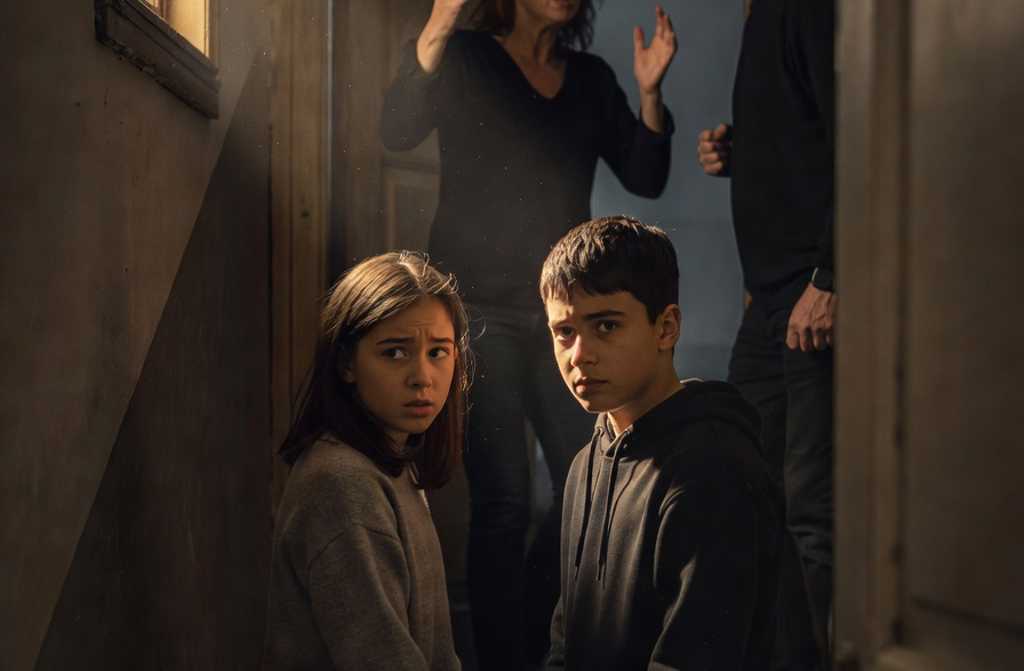
Years have passed since those troubled times in the Whitaker family, yet the memories linger like echoes from a distant chapter, reminding one how youthful resilience can carve out peace amid adult storms. “What on earth is wrong with you this time?! How much longer must this go on? I’ve had quite enough of it all!” The woman’s voice, rising from behind the door of one of the flats, rang out across the entire stairwell.
At that instant, Charlotte and Matthew were making their way up the stairs. They froze in place, as though striking an unseen wall. For a fleeting second their eyes met, and in that brief look no words were necessary. Both grasped the situation without a sound: it would be wiser to turn back now. Sighing together, they pivoted and slipped quietly away from the building. Returning to the flat that evening was clearly not in their plans.
Who would choose to pass an evening listening to endless parental rows? Certainly not them! The pair strode purposefully toward the next building, where their grandmother Catherine lived. In recent years her flat had turned into their real refuge. What had once been weekend visits had become almost nightly shelter.
The mood in their parents’ home had long grown unbearable. The parents, lost in their own world, yelled at each other without end. Worse still, they more and more often tried to pull the children into these disputes.
The mother would suddenly swing toward her daughter and demand, “Tell me, am I not right? You agree with me, don’t you?”
The father would cut in before any reply, turning to his son: “No, I’m the one who’s right here! Back me up!”
Charlotte and Matthew stayed quiet. They had no wish to take sides or join the unending clash. They simply longed for calm, quiet, and warmth, all of which they found at their grandmother’s.
Such scenes repeated day after day, like a worn-out tune that no one dared halt. The children had grown skilled at spotting the early signs: the pitch of a voice, the sharpness in movements, the glances the parents exchanged. All these became signals that it was time to slip away. Who would enjoy living under constant strain, where any talk could flare into a loud row in a moment?
The young ones could not puzzle out what had sparked this upheaval. Their family had never been flawless, not like those shown in advertisements, but before the parents had known how to reach agreements! Rows happened, to be sure, but they ended not in shouts but in steady talks. The mother might look cross, the father might raise his voice a little, yet half an hour later all was settled. Everyone would gather at the table again, sip tea, and map out weekend plans.
Roughly two years earlier everything had shifted. It felt as if someone had quietly swapped the old parents for new ones who now found cause to argue over the smallest matters. A dirty mug left on the table? A lengthy speech on carelessness and lack of respect. A shirt hung on the wrong peg? Reason for cutting remarks about order in the house. A teaspoon left in the sink? Near a crime, deserving minutes of debate!
One evening Charlotte sat in her grandmother’s kitchen, idly stirring her tea. She stayed silent for a while, watching the amber swirls in the cup, then asked with a touch of bitterness, “How can this happen, Grandmother? Everything changed after their holiday together. What went on there?”
Catherine paused, set her cup on the saucer, and gently touched Charlotte’s hand. She herself only guessed at the causes of the family rift, and those guesses brought her no joy.
“Adults will work it out themselves,” she answered softly, aiming to keep her voice steady. “Sometimes people need time to decide the right step.”
Charlotte nodded, yet doubt showed in her eyes. She sensed her grandmother held something back, but she did not push. What use? While treated as a child, nothing serious would be shared.
“We can’t stand these shouts anymore!” Matthew cried out with despair. “We can’t finish homework properly or read a book! I can’t even recall the last time we all sat at the table together. If it’s so hard for them to stay together, they should separate, and it would ease things for everyone!”
The words burst out on their own, carrying the truth of recent months. Matthew spoke not just for himself; he knew his sister felt the same. Peace had vanished from their home long ago: the mother would snap something, the father would answer with irritation, and soon another row would erupt with nowhere to hide.
“Matthew,” Grandmother said, taken aback. She laid aside her knitting, studied her grandson closely, and slowly shook her head. “Have you thought what will follow if they part? You’ll have to be split up. Are you ready to live apart from Charlotte?”
“We’ll live with you!” Charlotte spoke at once, gazing at her grandmother with pleading eyes. “We’re here almost all the time anyway! You wouldn’t mind, would you?”
Catherine stood still. She understood her grandchildren’s feelings, seeing how hard things had grown for them, how worn they were by the endless parental rows. On one side, the children would indeed be safe here, in a steady, kind setting where homework could be done without noise, books read in quiet, and a sense of protection felt. She loved them deeply and stood ready to wrap them in care.
On the other side, what of their parents? How to explain that the children no longer wished to stay at home? Would they accept such a plan? And if they did, how might it shape their ties with the children? Could this step lead to a full break with the parents?
“Let’s not hurry,” the woman said after a deep breath. “I’m always glad to have you here, you know that. But first let’s try speaking with your mother and father. Perhaps together we can find a way to mend things.”
“Don’t worry, we’ll speak with them ourselves,” Charlotte declared with confidence, smiling brightly. Grandmother had nearly consented, and that mattered most! “Just don’t turn us down, please! We truly can’t stay there any longer! It will be better for them apart, or one day they might truly harm each other! I saw Dad raise his hand to Mum yesterday. He didn’t strike her, truly! But he was close to it.”
Charlotte grew quiet, recalling that dreadful moment. She had entered the kitchen for a glass of water and halted in the doorway: her father stood half-turned toward her mother, his arm suddenly lifted, while her mother instinctively shrank back. A second later the father dropped his arm, yet that second had stretched into forever for Charlotte.
“Grandmother, say yes!” Matthew backed his sister. He stepped nearer and took her hand, as though fearing she might refuse. “We’ll help you with every household task. Just don’t send us back there. They pay us no mind at all! Yesterday I went to Dad and told him about the parents’ meeting. Do you know his reply? ‘Ask your mother!’ So I did. Guess what she said?”
“Ask your father?” Catherine inquired softly, already knowing.
“Right!” Matthew gave a bitter laugh. “Then they argued for two more hours over who would attend. They stayed in separate rooms and shouted across the hallway. I just stood and listened.”
“I asked them to sign a form for a museum outing,” Charlotte added, eyes down. Her fingers tugged nervously at her sleeve edge. “Now I’m the only one in class who won’t go. Neither signed the paper. Instead they started rowing again; Mum shouted it was Dad’s duty, while Dad claimed Mum should handle school affairs.”
Catherine watched her grandchildren and saw their deep weariness. Their eyes held not a child’s tiredness, but the sort built over months when each day mirrored the last, when family warmth gave way to constant rows and support turned to indifference.
“It’s always this way,” Matthew sighed, shoulders drooping. His voice carried fatigue, as though said hundreds of times before. “Any request from us sparks a fresh row. We don’t even want to return home. A few days ago we arrived at eleven at night, and do you think they scolded us? No! They simply sent us to bed without asking where we’d been. Yet later they spent ages blaming each other for bad upbringing.”
The teenagers sighed together once more. In recent months they had seriously weighed divorce as the sole escape. Yet they dreaded the separation from each other that would surely follow. One would remain with Mum, the other with Dad, and their close bond would shrink to occasional weekend visits.
They weighed choices in whispers during evenings alone in their room. Once Matthew jokingly proposed running away, simply grabbing bags and heading wherever sight led. He said it smiling, trying to ease the air, but Charlotte took the notion in earnest. Her eyes brightened briefly, then she murmured, “What if we truly left? Even for a few days?” In that instant both saw how unbearable the home had grown, so that even flight seemed less mad.
Then the idea struck: Grandmother! Why not move in with her? The thought came to both together, as if in shared mind. Charlotte voiced it first: “What if we ask Grandmother to let us live here? She won’t shout or argue, and we won’t hear these endless rows.” Matthew caught on at once: “Yes! She’s kind and always backs us. Her flat is large enough for us.”
They began picturing a fresh life: quiet breakfasts, homework done in stillness, evenings at board games with Grandmother. No shouts, no blame, no need to hide in their room to dodge the heat. For the first time in ages hope stirred in their hearts. Let the parents settle their own matters; the twins would at last gain calm. That was what filled Charlotte and Matthew as they imagined life with their grandmother.
“Mum, Dad, we need to talk seriously,” the twins said firmly, facing their parents. They had waited until evening when both were home, then entered the sitting room with resolve. Charlotte gripped Matthew’s hand tightly, finding it easier to hold steady. “But first promise to hear us out fully before sharing your views.”
Richard set aside his phone and glanced up in surprise. Anne, sorting items on the sofa, straightened sharply. Her face showed she thought the children had said something unthinkable.
“This is all your doing!” she huffed, arms folded. “The children are now laying down rules! As if we must answer to them!”
“And listen to who’s speaking!” the man shot back at once, dropping the phone. “I’m always working to support the family. You’ve been with them all along! What have you taught them? Why are they now in charge?”
The twins looked at each other. They had braced for this, the talk sliding straight into the usual blame game. Yet retreat was impossible.
“Stop!” Charlotte cried, near tears. She stepped forward, striving for clear, calm words though her insides shook. “Matthew and I have thought it over and decided you must divorce.”
The room fell silent at once. Anne stood with mouth half open, while Richard rose slowly from the sofa.
“That’s news!” the mother’s voice turned sharp. “Charlotte, you’re still too young to tell grown-ups how to live! And what else have you ‘decided’? Perhaps you’ll split the flat for us as well?”
“If you don’t divorce, we’ll go to social services,” Matthew tightened his hold on his sister’s hand, drawing strength from it. His voice stayed firm, though he scarcely believed his own words. “Then, Dad, you could lose your job. Your firm dislikes scandals, doesn’t it? You said yourself reputation matters most.”
“And you, Mum,” Charlotte went on, meeting her mother’s eyes, “will lose the neighbours’ respect. They won’t even speak to you! Everyone knows how you shout at each other, and we’ll fill in the rest!”
“They’re threatening us! Look at them!” Anne burst out at last, glancing between the children. “These are our own! How can you treat us this way?”
“We’re not threatening,” Matthew said quietly yet surely. “We just want you to see we can’t go on like this. We’re worn out! Worn from the shouts, from you not hearing us, from simple requests becoming rows.”
“You’ll divorce and live apart, and we’ll stay with Grandmother,” the twins finished together, as rehearsed. “It will suit everyone: peace for us, no constant fights for you. We won’t be caught between you any longer.”
The parents stood still. For the first time in ages they found no reply. In such talks they usually leapt to argue and point fingers, but now both seemed struck dumb.
Their thirteen-year-old children acted in ways wholly unexpected! Charlotte and Matthew stood side by side, hands linked, gazing at their parents with steady eyes free of usual shyness. They spoke of grave matters the adults themselves avoided thinking about.
The couple had considered divorce more than once. Yet one question always halted them: with whom would the children remain? Splitting the twins felt impossible; they were so close, always together, always supporting one another. The parents could not picture tearing one from the other, forcing separate homes and mere weekend meetings.
The idea of Grandmother had never crossed their minds before. Perhaps both had been too wrapped in grievances and claims. Now, hearing the children’s offer, Richard and Anne wondered: might this be the answer? Grandmother loved the twins, her flat was roomy, she welcomed them always. Perhaps this would ease at least some troubles?
“I’ll ring Mum,” Richard said at last through clenched teeth, his voice thick as if words came hard. “If she agrees.”
He never finished. Anne cut in sharply, her tone carrying a weariness that startled even her:
“Then we can finally cease tormenting each other. Ring her. I’ll be glad not to see your face each day.”
Her words lingered. She had not meant to sound so cutting, yet years of stored hurts let them slip free.
“And how glad I’ll be!” Richard answered, masking his pain with irony.
No anger colored his tone, only a bitter smile at what their life had become. He drew out his phone and slowly tapped his mother’s number. As rings sounded, both spouses looked away, avoiding glances. They did not yet know the outcome, but sensed the point of no return might already lie behind them.
That day the Whitaker family reached a turning decision. It began with a long talk between Richard and his mother. Catherine listened closely, interrupting only now and then with questions.
When Richard finished laying it out, a pause followed. Grandmother breathed deeply and said, “If you both see this as best for the children, I agree. They will be safe here; I shall look after them.”
By evening the couple met in the kitchen, the first time in ages without shouts or reproaches. They sat facing each other and discussed details. Step by step they settled on one point: divorce offered the only sensible path. The children would move to Grandmother’s, and the parents would send monthly sums for their upkeep.
Neither meant to leave the children adrift. Both father and mother pledged weekend visits, yet on separate days to limit their own contact.
“I’ll come Saturday morning and take them out, you on Sunday,” Richard said wearily, and his wife nodded. “That will simplify matters. The main thing is the children must not feel cast aside.”
Their aim was to cut communication and so avoid fresh clashes. They agreed not to speak ill of each other before the children, not to sway them, not to argue in their presence.
“We remain their parents,” Richard said. “And must stay so, even if no longer husband and wife.”
As time proved, the choice worked well. The children at last relaxed and lived as ordinary teenagers. Charlotte joined an art club, long wished for but earlier blocked by constant worry. Matthew took up football and made new friends on the team. They once more spent time together: strolled through town, visited the cinema, talked of school without dread of sudden rows.
Steady ground returned to their studies too. They now had a quiet spot for lessons, free of shouts or disputes. Homework was completed calmly, and this soon showed in better marks. Teachers remarked on the shift: “You’ve grown so focused, you two! Keep going!”
Life gradually settled into a new rhythm, not perfect yet steady and foreseeable. The children no longer hid in their room, no longer started at loud voices, no longer fretted over each move. They simply lived as teenagers should when fortunate enough to find support amid hard times.
Five years on, life for the Whitaker family moved at a steady, quiet pace. Charlotte and Matthew had grown used to the new pattern: lessons, clubs, time with friends, warm evenings with Grandmother. The parents still called on alternate days, each on their own, bringing gifts and care but no mutual grievances. Over those years they had learned to speak with restraint and courtesy, without old flares of temper.
The first direct meeting between the former spouses came at the twins’ graduation evening. The school held a formal event, and both parents attended. They began warily, taking seats at opposite sides of the hall, yet the frost slowly thawed.
When dancing started, Richard approached Anne unexpectedly: “Shall we dance? Recall old times.”
She paused briefly, then nodded.
After the event they sat long in the school yard, watching graduates laugh by the fountain. Talk arose naturally, first of the children, then of earlier days.
They spoke much that night, recalling joyful times from their marriage and acting with proper dignity. They dwelt not on past hurts but on the good that had once bound them. The twins, observing from afar, could scarcely contain their joy. It had pained them to watch two dearest people treat each other almost as foes.
Yet suddenly, without warning, matters shifted. The next day Richard and Anne invited the children to a café. Over tea they glanced at one another, clasped hands, and Richard announced with a broad smile, “Children, your mother and I have decided to marry again. In these years we’ve seen our feelings never died. We still love each other and wish to become a family once more.”
His voice rang joyful, as if sharing life’s finest news. Anne glowed, plainly awaiting delight.
The twins exchanged looks, faces darkening at once. Distrust flickered in Charlotte’s eyes; Matthew’s fists tightened beneath the table. The same errors again! What ran through their parents’ minds? Could they share a home without clashes?
“Are you serious?” Charlotte managed.
“Completely,” Richard answered with assurance. “We have both changed. Learned to listen. We want to give our family another chance.”
The children stayed silent. Mixed feelings churned within: they wished to trust the parents had truly altered, yet feared the old pain returning.
Still, Charlotte and Matthew offered no discouragement. They gave no comment at all, deeply wounding their parents. Anne stared in bewilderment: “Aren’t you pleased? We thought you’d be happy for us.”
The twins merely glanced at each other and shrugged. What could they say? “Don’t do this! Don’t wreck your lives!” Words lodged in their throats. They had no wish to seem heartless, yet could not feign joy either.
The rest of the meeting dragged. Parents spoke of plans; children nodded politely, thoughts elsewhere. On the way home Charlotte murmured to her brother, “I hope they know what they’re doing.”
Matthew sighed in reply.
“So we’re heading to London?” Charlotte opened her laptop, ready to scan university sites. “Far from this madness. I can already picture how this circus will close!”
“Of course we’re going,” Matthew said firmly, weariness beyond his years in his tone. He passed a hand through his hair as if shedding the weight of recent months. “They’ll manage peacefully a month, two at most. Then it restarts: shouts, slammed doors, blame. I refuse to stay hostage to their bond. I won’t wake each morning wondering their mood and who will face the next flood of complaints.”
He rose and paced, gathering scattered books by habit. One thought circled: why do adults, meant to model wisdom and steadiness, act like restless youths? Why repeat the same errors instead of mending matters?
“We must leave,” he repeated, pausing at the window. Twilight settled outside, tinting the town in soft orange. Matthew gazed far, as if seeking his future there. “Far enough their rows cannot reach us. Let them handle their own affairs. We are no longer their counsellors, go-betweens, or targets. We have our own lives, our dreams, and I will not let another round of parental folly destroy them.”
“When do we send applications?” Charlotte asked calmly.
“Tomorrow,” Matthew replied without pause. “To avoid any second thoughts.”
The girl nodded without a word, eyes on the screen. London university pages flickered as she had studied courses, hall conditions, and job prospects after graduation for a week. Lists in her notebook beside the laptop grew: advantages and drawbacks of each place, required papers, deadlines, admissions contacts.
“Mainly to study in peace, free of their disputes,” she said softly, as if concluding her thoughts. “Good we’ll be so distant.”
“Precisely,” Matthew agreed, settling beside her. He leaned in to read the lines. “When they again debate blame, we won’t even hear. Let them ring, moan, summon us to family talks; we take no part. Their wish to ‘give the relationship another chance’,” he smiled wryly, “remains their choice, not ours.”
Anne and Richard did hold a second wedding. This time they chose against any grand affair: no wish for needless cost, no desire for notice, and, truthfully, no sense they needed anything large. They kept to a simple ceremony at the registry office and a meal with closest kin, parents, a few friends, and the children.
In photos from the day they appeared truly content. Smiles, linked hands, tender looks passed between them. Intertwined fingers, gentle gazes, light touches showed in the images. It seemed all hurts forgotten, the years apart helpful, that now they knew their wants and only brightness lay ahead. The children, viewing the pictures, could not help wondering: might this time truly differ?
Yet alas, no. The first weeks after the wedding passed in surprising calm: the couple strove for greater care, offered thanks more often, overlooked small faults. Gradually old patterns crept back. Within a month raised voices returned to their flat. At first came quiet but pointed reproaches: “You left a mess again?”, “Why not warn you’d be late?”, “You might have helped, being home.”
Open clashes followed. Rows sprang from trifles: wet towels in the bathroom, forgotten bread, loud television. Words grew sharper, voices louder, gaps between rows shorter.
After two months, as Matthew had foreseen, tension peaked. One evening a dispute over who should shop groceries swelled into a storm. Richard, losing hold, hurled a cup at the wall in rage; it smashed loudly, pieces scattering across the kitchen. Anne, equally furious, seized a plate and dashed it to the floor. The crash of breaking china echoed through the flat.
After such scenes the parents always tried to reach the children. Each call began alike: one dialled while still breathless from the row and poured out stored hurts.
“Can you imagine what he said today?” Anne wept as Charlotte answered. “He makes no effort to understand me!”
“Son, you must grasp my side; she has no control,” Richard told Matthew anxiously. “I try, truly, yet she seems to hunt for cause!”
Charlotte and Matthew had learned to cut these talks short with gentle firmness. They no longer entered long debates or judged right and wrong. Answers stayed brief yet steady.
“Mum, I’m in a lecture now; I’ll ring later,” Charlotte said calmly, eyeing the clock: twenty minutes remained, yet she wanted no further monologue.
“Dad, urgent work calls; we’ll discuss this weekend,” Matthew replied, gaze on his laptop. He knew letting a parent vent would stretch the call an hour, then require soothing too.
“Later” and “weekend” always slipped away. The children found reasons: studies, part-time jobs, friends, and calls from parents grew rarer. Charlotte and Matthew felt no guilt; they simply guarded their peace and hours, aware they could not alter what passed between their mother and father.
The twins truly possessed their own life, full and purposeful, distant from parental dramas. Each day now held their own cares, interests, and plans, not waiting for the next row beyond the wall.
Charlotte gave herself to psychology. She enjoyed tracing how the human mind worked, why people acted as they did, how to aid those in hardship. In her third year she began volunteering at a centre for teenagers from troubled homes. There she led group sessions, helped the young express feelings and find paths through difficulties. Charlotte saw in them reflections of her own past and sought to offer what she once lacked: attention, backing, the sense of being heard.
Matthew found his place in information technology. From early years he took to programming, drawn by the logic of code, the power to build working systems and solve knotty technical issues. He spent hours at the computer, mastered new languages, joined student competitions. In his fourth year his team placed third in a regional event for mobile applications, boosting his confidence and confirming his direction. Matthew secured part-time work at a small IT firm, where he soon proved reliable and able. On real projects he learned to work with colleagues, manage time, and handle unusual cases.
The twins began shaping a future without reference to parental rows. Charlotte hoped to start her own practice, aiding families to find common ground. Matthew considered his own venture. They discussed plans over tea in cafés, drew schemes, noted ideas in notebooks. In those moments they felt they had support, a direction, a life belonging solely to them.
When Anne and Richard again sought to draw them in, calling in tears to describe how poorly things stood and how they failed to understand each other, the twins answered with calm resolve. They had planned beforehand how to handle the call without faltering or slipping into their old role as go-betweens.
“Enough, dear parents; settle this yourselves,” Charlotte said firmly. “You have your life; we have ours.”
“But you are our children!” Anne sobbed. “You ought to back us!”
“If you acted properly instead of like children, we would support you,” Matthew replied at once. “You erred by remarrying and still torment each other. You cannot share space civilly, so why keep hurting one another? Divorce and separate already.”
The words might have seemed harsh, yet brother and sister simply wished for peaceful lives. Looking back across the years, it becomes plain that by drawing firm lines Charlotte and Matthew stepped free of repeating cycles, building paths of their own.
Leave a Reply