19May 2023
The sting of the leather never hurt as much as the words that came before it. If your mother hadnt died, I would never have had to carry you, she snarled, and the whip cracked through the cold air. The leather sang, the skin split soundlessly, and the boy did not scream. He simply pressed his lips together, as if he had learned that pain is survived in silence.
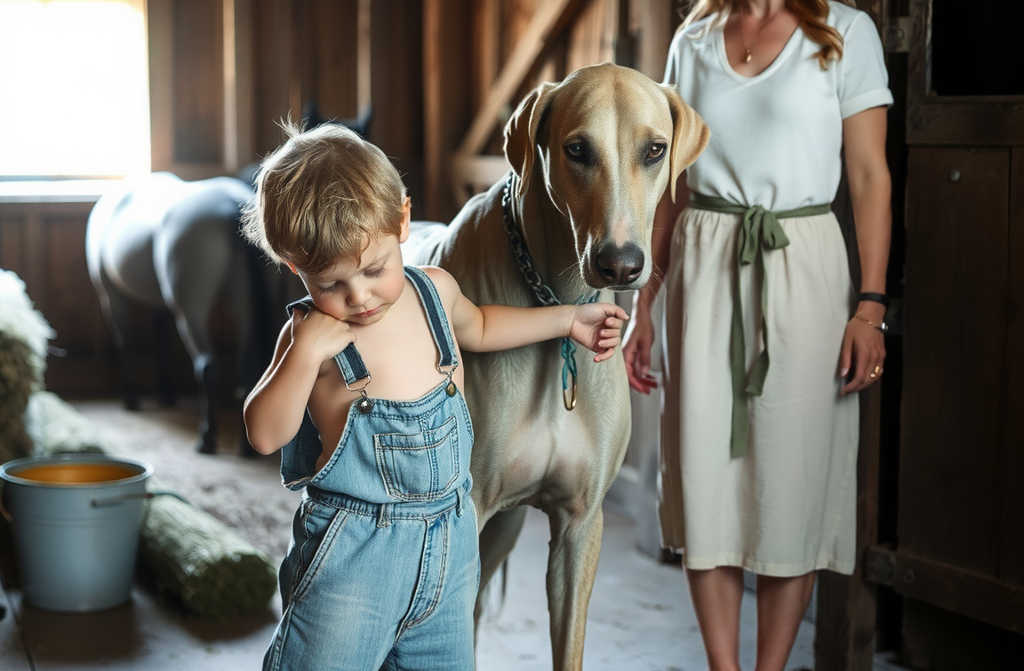
James was five years oldfive, and already aware that some mothers never love, that some houses teach you to breathe only shallowly. That afternoon, in the old barn, the tired mare thudded the ground with her iron shoe, while a gaunt brown dog watched from the gate, eyes dark and steady, eyes that had witnessed wars and would soon watch another.
The wind over the Yorkshire hills whistled dryly that morning as we gathered in the yard. The earth was hard, cracked like the boys thin lips as he dragged a bucket of water. James, though five, moved as if he were much older. He had learned to walk without a sound, to breathe only when no one was watching.
The bucket was nearly empty when he reached the trough. A horse stared at him, a grey mare named Mist, her coat speckled, her eyes cloudy with a gentle mist. She never neighed, never kicked, only watched. If you dont speak, I wont, James whispered, his palm brushing her flank. A sudden cry split the air like a flash of lightning. Another strikelate, cruelhit the animal.
Emma appeared at the barn door, riding crop in hand. She wore a freshly pressed linen dress, a daisy tucked behind her ear. From afar she seemed respectable; up close she smelled of vinegar and pentup rage. James let the bucket fall. The earth drank the water like a thirsty mouth. I told you the horses are fed before dawn, she snapped. Did your mother ever teach you that before she died, you worthless thing?
The boy did not answer. He lowered his head. The first lash cut across his back like a cold whip; the second struck lower. Mist kicked the ground. Look at me when I speak, she snarled. James simply closed his eyes. A nobodys son, she hissed. Sleep in the stables with the donkeys. From the farmhouse window, Eleanor watched.
Eleanor was seven, a pink ribbon in her hair, a new rag doll clasped to her arm. Her mother adored her. Mrs. Clarke treated her like a stain that would not wash out. That night, as the village gathered for prayers and the soft toll of church bells, Emma stayed awake in the straw, eyes hard, no tears left to spill.
Mist leaned her nose against the rotting wood that separated us. Do you understand? she said, voice low. You know what it feels like when nobody wants to see you. The horse blinked slowly, as if answering. A week later a convoy of government vans rolled down the dusty lane to the farm.
The vehicles bore brightorange vests, cameras hanging from necks, and a weary greymuzzled dog named Marlow. Beside him walked a tall, darkhaired woman from the South, Ms. Bennett, boots of wellscratched leather, a folder of papers. Routine inspection, she said with a courteous smile.
An anonymous report had reached us. Emma feigned surprise, opened her arms as if to offer the whole property. We have nothing to hide, Miss, she said. Perhaps someone is bored and looking for trouble. Marlow ignored the horses and goats, walked straight to the back stable where Fisher was sweeping away dung. The boy halted; the dog halted. No bark, no fearjust a long pause in which two broken souls recognised each other.
Marlow sat opposite James. He didnt sniff him, didnt touch him, simply stayed there, as if to say, Im here, I see you. Emma watched from a distance, her eyes narrowing like a snake basking in the sun.
Later, James whispered to Ms. Bennett, feigning a laugh, Hes got a talent for tragedy. I took him in out of pity. Hes not my sonjust a burden from my former husband. Ms. Bennett said nothing, but Marlow stepped forward, planting his body like a quiet wall between the boy and the world.
Emma tightened her grip on the crop. Can I help you, dog? she asked. Marlow only stared, and for a moment Emmas eyes drifted away, because in that look was something she could not tame nor fake. That night the farm grew colder. Emma drank more wine than usual. Little Lily, the youngest, hid with her doll, drawing houses where no one ever shouted.
In a dream, Lily imagined an embrace, not knowing whose. She only remembered the scent of damp earth and a warm snout against her cheek. Mist slapped the ground with her hoofonce, twice, three times. James opened his eyes and, between shadows, thought he saw Marlow lying outside the stable, watching, waiting, as if he knew night could not last forever.
The next morning a low fog clung to the fields, the kind that entwines dry branches, as if winter refused to let go. At the farms entrance a white van bearing the faded emblem of the Animal Welfare Service rolled in silently. Only the sparrows dared to chirp. Ms. Bennett stepped out first, boots caked in dry mud, a bluewoven scarf knitted by her grandmother back in Devon. Shed worn it for over twenty years, a sort of shield.
Behind her trotted a massive dog, coat a mix of cinnamon and ash, ears drooping, gait weary yet steady. Is this the place? Ms. Bennett asked the local farmer who accompanied her. Yes. The Navarre family have tended horses here for generations. Marlow, without waiting for instructions, sniffed the air, moved slowly to the old wooden gate, halted, and peered inside.
His breathing tightened on the other side of the yard. A child no older than five clutched a bucket of oats that seemed twice his weight. He shuffled his feet, didnt cry, but each step seemed a silent apology for being alive. Emma stepped out just in time to see the van. Her dress immaculate, makeup flawless. Animal care? she asked. No, just paperwork. She smiled thinly.
Everything is under control, Marlow growled low, unheard by anyone else. Ms. Bennett advanced politely. Good morning. Were here for a routine check. It will only take minutes. Sure, sure, Emma replied, no trouble here. The horses are healthy. She raised her voice, ignoring the boy.
James, the boy, bore an old scar on his neck, like dried leather. Marlow walked straight to him, didnt sniff, didnt ask permission, simply stood before James as if that frail frame were all that mattered. Oh, you, Emma muttered, laughing coldly. That boy always makes a fuss. He can cry without shedding a tear.
Ms. Bennett only glanced at the dog, then at the boy. James didnt move, but his dark eyes glittered with something older than fearsomething that had waited centuries to be seen. Marlow tilted his head, nudged Jamess hand with his nose. In that instant James did something no one had seen before: he reached out, brushed the dogs fur, his fingers trembling for only a breath.
Ms. Bennett crouched gently. Whats your name? she asked. The boy said nothing. Marlow settled beside him, as if to say, You need not speak. Hes shy, Emma said. And clumsy, honestly. We feed him, she added. He sleeps in the tool shedbetter than nothing, right? The comment floated like a drop of oil on clear water.
Ms. Bennett inspected the stables, asked to see the horses, asked short questions; everything seemed in ordertoo orderly. When she returned to the yard, James was gone. Marlow sat by the back door, motionless, as if he knew the secrets behind that door had no names yet.
Is that dog still on duty? Emma asked, disdainful. He looks retired. Ms. Bennett smiled faintly. Dogs like him never truly retire. They wait for their final mission. She stopped beside a rose bush that grew against the stone wallspines sharp, but a small shy blossom at its centre, timid as a heart refusing to close fully. And the girl? Nilda, the schoolteacher, asked later. Shes different now. She has character, not like the other children.
Ms. Bennett said nothing, only murmured, Sometimes the quiet one remembers the most. Marlow did not bark, but as he climbed into the van, he glanced once backnot at the house, but at the small stable window where a pair of dark eyes still watched. In that glance there was no plea, only patient waiting, as if someone finally began to listen.
The village of Whitford moved at a slow, ancient pace. Its cobbled streets kept stories that no one dared to tell, and the creaking doors seemed to complain about the nights whispers. Everyone knew something, yet they spoke of everything except the truth.
Emma walked through the market square in a tailored dress, nails painted bloodred. She greeted people with a crooked smile, as if she recalled the exact price of every favour shed ever granted. Hows the little one? asked the baker, voice soft as cotton. Stubborn as a mule, Emma replied. Dont worry.
I, Thomas Whitby, have watched this all unfold from my modest farmhouse. The dog, the boy, the cruel woman, the weary mareeach piece a thread in a tapestry of sorrow and quiet resilience.
A week later, a convoy of bluebadge officers arrived, followed by a social worker named Helen, notebook in hand, eyes bright but tired. She interviewed James for fifteen minutes on the porch while Eleanor played with her new doll a few metres away. No signs of trauma, she noted. A quiet child, not unusual. She asked, Any family history of autism? without meeting his gaze. Emma snickered, All he has is laziness and a need for attention. If it werent for me, hed be starving in an alley. Helen filed the report and left before the church bells rang.
That evening Marlow returned, lying in front of the gate, refusing to move. When Emma brandished the crop, the dog growled lownot out of teeth but out of soul. Again you, she spat, advancing. Marlows eyes were two embers in the mud, and Emma heard everything. She did not speak, but she clutched a sketch hidden under a sack of straw: a boy from behind, red marks on his skin, a sad dog, a faceless woman with a broken whip at her feet.
The next day a stranger delivered an anonymous letter to the town hall. It bore only one clumsy sentence: What you keep quiet also hurts. The man who read it burned it in the stove, hands shaking.
On a Saturday, while the village fair set up in the square, James carried a bucket of water, his younger brother Nil chasing after him, cotton candy in hand, humming without looking at his sibling. You know what my mum said? Nil shouted. She said youre not even my own. You came with the fleas. James gave no answer, walked faster, his boots scraping the earth.
Behind the fence, Marlow lifted his ears, walked parallel to James as if his steps were an echo. He did not bark, but his shadow grew with each turn of the sun. That night, the mare Mist struck the stable door three times, then fell silent, as if signalling a code only Marlow understood. Marlow answered with a dry bark, then lay down, eyes never closing.
The following morning Ms. Bennett approached me. What are you teaching me, old friend? she asked quietly. A day later, someone opened the stable gate without anyone knowing how. At dawn Marlow was inside, lying beside Fisher, who slept in the hay, covered only by an old sack. The dog rested a paw on the boys chest, as if making sure he still breathed. Emma burst in, curses flying. Damned fleadog, off my property! James woke, did not cry, only placed his hand on Marlows head, soft as a blessing. For the first time he whispered, Youre not leaving. The word cut through the air like a knife.
Emma froze, not from the voice but from the way he looked. There was no fear in those eyes, only an ancient sorrow that could no longer fit inside a childs body. Something broke that daynot Emma, not the village, but the silence that had cloaked the farm for years.
Later, a grumpy neighbour named Harold confronted Ms. Bennett in the community centre, I dont trust people, but I do trust dogs. He pointed at Marlow, That old dog is telling the truth. The crowd murmured, the tension thick as fog.
Weeks passed, and the farm grew colder. Emma drank more wine, Lily tucked herself into a corner with her doll, drawing houses where no one screamed. James, his lips cracked, a purple bruise blooming behind his ear, whispered to a girl named Violet, They blamed me for breaking the broom. Violet stared back, Youre a savage, you said. Emmas whip fell without pause, and she muttered, If you dont learn with words, youll learn with scars. Marlow watched from the shadow of the barn, his growl a low thunder.
He leapt at the gate, tore the whip from Emmas hands, shredded the leather into black shards. Emma stepped back, That dogs mad! she shrieked. Marlow did not look at her; his stare was fixed on Fisher, whose eyes were ashgrey, understanding without question. The old dogs silence was louder than any bark.
For a moment James opened his mouth, barely a sigh, and said, Thank you. That simple gratitude hung in the stale air longer than any accusation.
That night Dr. Edward came to the stable, not for Lily but to check a pregnant mare. He saw the boys wound, the old dog curled at the doorway like a guardian of bygone times. He said nothing, took no pictures, merely watched. In his eyes lingered a memory, a recognition that some pain stretches beyond medicine.
Later, as I sat on a stone outside the stable, I realised that the silence we had all endured was not an absence of sound but a weighta blanket of damp wool on our shoulders. I had learned, through the boys quiet resilience and the dogs steadfast gaze, that sometimes the strongest voices are the ones that never raise their volume.
**Lesson:**You do not need a whip or a courtroom to be heard. Sometimes all it takes is a steady eye, a patient ear, and the willingness to sit beside the wounded until they find the courage to speak.
Leave a Reply