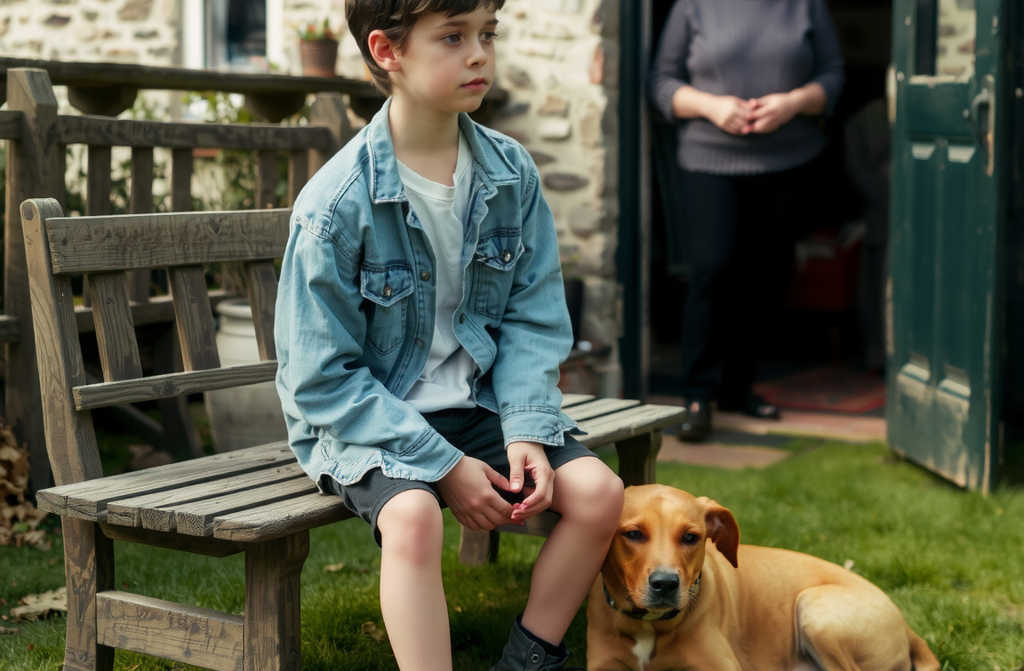
It wasnt the leash that hurt the most. It was the sentence that came before the blow. If your mother hadnt died, I would never have had to carry you. The leather cracked in the air. Flesh split without a sound. The boy didnt scream; not a single tear fell. He simply pressed his lips together, as if he had learned that pain must be endured in silence.
Isaac Smith was five. Five. And he already knew that some mothers never love, that some houses teach you to hold your breath. That afternoon, in the barn, while the old mare hammered the ground with her hooves, a darkeyed hound watched from the gate, eyes still, eyes that had known war and would soon know it again.
The hill wind whistled dryly that morning over the yard. The earth was hard, cracked like the boys lips as he dragged a bucket of water. Isaac was five, but his steps belonged to someone older. He had learned to walk without a sound, to breathe only when no one was looking.
The bucket was nearly empty when he reached the trough. A horse stared at him in silence. Old Mist, mottled coat and fogclouded eyes, never whinnied, never kicked. She only watched. Quiet, then, Isaac whispered, laying his palm along her flank. If you wont speak, I wont either. A shout sliced the air like a bolt. Late again, you brute.
Eleanor Blake appeared at the barn door, riding crop in hand. She wore a crisp white linen dress, buttoned and starched, a single flower tucked in her hair. From afar she seemed respectable; up close she reeked of vinegar and contained fury. Isaac dropped the bucket; the earth drank the water like a parched mouth. I told you the horses feed before dawn, she snapped.
Was your mother never teach you that before she died a fool? she spat. The boy didnt answer. He lowered his head. The first strike crossed his back like an icy lash. The second fell lower. Mist kicked the ground. Look at me when I speak. Yet Isaac only closed his eyes. A son of nobody. Thats what you are. You belong in the stable with the other beasts. From the house window, Margaret Jones watched.
She was seven, a pink ribbon in her hair, a new doll clutched to her chest. Her mother adored her. Harriet Clarke treated her like a stain that never washed out. That night, as the village gathered in prayer and the soft toll of bells, Eleanor stayed awake in the hay, unmoving, unweeping.
Mist leaned against the rotten wood that divided them. Do you understand? he said without raising his voice. You know what it feels like when no one wants to see you. The horse blinked slowly, as if answering. A week later, a convoy rolled down the dusty lane of the farm.
White vans bearing government insignia, brightvested inspectors, cameras hanging from their collars, moved at a measured pace. An old greyhound, muzzle tired, eyes that had seen more than any man could bear, trotted beside them. His name was Rex. Beside him walked Inspector Bailey, a tall, darkhaired woman from the south, boots of rugged leather, a folder full of papers. Routine inspection, she said, smiling politely.
An anonymous tip had come in. Eleanor feigned surprise, flung her arms wide as if offering her home. We have nothing to hide, miss, she replied. Perhaps someone in this village is bored and looking for trouble. Rex paid no mind to horses or goats.
He stalked straight to the rear pen where Fisher was sweeping dung. The boy froze. The dog also halted. No bark, no fearjust a long pause in which two broken souls recognized each other. Rex settled opposite Isaac. He didnt sniff, didnt touchhe simply sat, as if saying, Im here, I see you. Eleanor watched from afar, eyes narrowing like a snake in the sun.
Later, the boy whispered to Bailey, chuckling falsely, He has a talent for tragedy. Hes always making things up. I took him in out of pity. He isnt my son. Hes a burden from my previous marriage. Bailey gave no answer, but Rex did. He placed himself before Isaac, his body a quiet wall.
Eleanor tensed. Can I help, dog? Rex didnt move. He only stared, and for a heartbeat Eleanor averted her gaze, because in that look lay something she could neither tame nor fake. That night the farm grew colder. Eleanor drank more wine than usual. Margaret hid with her doll, drawing houses where no one screamed.
Isaac dreamed for the first time in ages of an embrace. He didnt know whose, only the scent of damp earth and a warm muzzle against his cheek. Mist struck the ground with her hoovesone, two, three times. The boy opened his eyes and, through shadow, thought he saw Rex curled outside the pen, watching, waiting, as if he knew the night could not last forever.
Morning broke in a low fog that tangled the dry branches, as if winter refused to let go. At the farms entrance a white van with a faded animalwelfare badge rolled in silence. The Northumberland County Council van halted. Only the sparrows dared to sing. Bailey stepped out first, boots caked in dry mud, a skyblue knitted scarf her grandmother had given her in Devon twenty years agoher shield.
A huge, cinnamonash dog followed, ears drooping, gait weary but steady. Is this the place? Bailey asked the farmhand beside her. Yes. The Navarro family have tended horses here for generations. Rex sniffed the air, moved toward the weathered gate, stopped, and peered inside.
On the other side of the yard, a child no older than five lugged a heavy bucket of oats, dragging his feet. He didnt cry, but each step seemed to apologise for his very existence. Eleanor emerged just in time to see the vehicle. Her dress immaculate, makeup flawless. Animal assistance? she asked. No, perfect.
Everything is under control, Rex growled low, a sound only the farms dogs could hear. Bailey advanced with courteous smile. Good morning. Were here for the routine check. Itll only take a few minutes. Of course, Eleanor replied, no trouble here. The horses are healthy. Then, louder, she pointed at Isaac. Stop that, you
Rex trotted straight to the boy. He didnt sniff, didnt ask permission. He simply stood before Isaac, as if that thin, trembling frame were all that mattered. No, Eleanor hissed, laughing coldly. That child always puts on a show. He cries without shedding a tear. She turned away, eyes flashing.
The courtroom in York felt like a stonecapped cellar, the walls thick with history, the judges clock ticking the only sound. The judge, a stern woman named Judge Ortega, flipped through the file with deliberate care. Proceed, she said at last. Ms. Blake is charged with physical and psychological abuse of her stepson, Isaac Smith. Blake answered with a sideways smile. Your Honour, that boy is a problem. He invents things, hides like an animal, then cries for attention. He never understood discipline.
Rex, now standing beside Isaac, lifted his head, ears pricked, as though the word discipline had burned his back. Isaac lowered his gaze but didnt weep. The judge called for evidence. A sealed envelope was placed on the table. Inside lay only drawings: a wounded horse, a hunched child, a raised hand with a belt, always a dog at the childs side. Nilda watched from the witness bench, swallowing hard. Her mothers eyes never met hers; she crossed her arms like someone at a tedious dinner.
Judge Ortega asked the girl, Do you have anything to say? The child looked up, as if wings were sprouting from her shoulders. At first I thought Isaac was exaggerating. My mother used to say that. Once, once I was hit. Only once, because I broke a glass and felt like theyd shattered me inside. Blakes lips tightened. An accident. A mild correction. All mothers do that. The judge replied calmly, Mothers who love do not need to correct through fear.
The room fell quiet like an old prayer. Mateo, the village handyman, rose. He wore a threadbare flat cap and clutched an old notebook. I have no formal training, he said, but Ive heard the leather cracking against flesh for two years, a tiny whimper like a wounded dog. And nothing was done! He shouted, I was cowardly, but today I speak what should have been said long ago. The judge nodded.
Rex rose, walked to the centre of the room, and sat opposite Blake, staring so intently that it seemed he were asking, Can you sleep at night? Isaac then stood, his feet barely touching the floor, his voice low but clear. She never saw me. She only screamed at me as if I were a shadow. Rex saw me. Mist saw me. And Ive learned that if an animal can defend me, I can defend myself. Blake opened her mouth, but no words came.
The judge closed the file, inhaled, and said, This court does not only judge by law, but by memory. A childs memory is not erased by excuses. She handed down the sentence: three years conditional imprisonment, permanent loss of custody, mandatory supervised therapy. Blake did not weep, but she did not smile eitherrelief, not fear.
Isaac stepped down, walked to Rex, embraced him softly, and whispered, Its over. I dont have to hide any more. Rex rested his head on the boys chest, and for the first time since they entered the courtroom, peace settled over the room. Judge Ortega paused at the door, bent low, and murmured to Rex, Good boy. The afternoon light spilled like slowblooming flowers across the streets, and somewhere far from the paperwork, a child began to believe his small voice mattered.
The field behind the farm was cloaked in fresh dew, not the old mares tired eyes but the gentle moisture that blankets earth before the sun musters the courage to rise. Isaac walked barefoot through the furrows, trousers rolled, hands in the pockets of a toolarge jacket. Rex followed, leashfree, silent, unhurried.
They stopped at the barn fence where the wind always seemed a little stronger, as if trying to carry away memories no one dared name. Isaac looked up at the hill. Mist grazed peacefully, no longer a relic of the past but a part of a present where no pain existed.
Heres where Im not called useless, not a burden, Isaac murmured. Rex tilted his head, as if he understood every syllable. They let me be silent, but not the silence that weighed like a soaked blanket on my shoulders. This is differentsilence of sunrise, of fresh bread, of a hug that makes no sound. Margaret watched from the kitchen window, a mug of tea in her hands. The house was simple stone, thickwalled, with framed photos of those who had goneher husband, her son, a mother who prayed by candle each All Souls night. Her words, when she spoke, fell like seeds, taking root when least expected.
Rex, now a permanent fixture of the home, slept under the table, snoring softly. He no longer chased squirrels, no longer barked at visitors. He simply existed as a beacon, a silent promise: You are safe here.
The judges letter, signed by Judge Miller, arrived in firm hands. The law finally recognized that Isaac had a right to a home without fear, that no oneleast of all Blakecould claim him again. The seal was dry, but the words were heavy. Margaret read it twice, then walked to the barn and handed the paper to Isaac.
It says you can stay forever if you wish. Isaac didnt answer immediately. He only stroked Mist behind the ear, where the itch always lived. I can keep sleeping in the little room with Rex, he said, nodding as Rex wagged his tail. Margaret smiled, her hair rustling like wheat in a gentle breeze. A week later, Eleanors daughter, Lily, was transferred to a specialist centre. No one forced her to speak; they simply showed her Isaacs drawings and something inside her brokenot in anger, but in truth.
Mom doesnt love me, Lily whispered before falling asleep, clutching a borrowed teddy bear. That afternoon, while Rex lay in the sun like a warm stone, Isaac approached, holding a fresh drawinga child walking a field with a dog, both heading toward a horizon blooming with flowers.
Thats all I have, Isaac said, placing the sketch between Rexs paws. I dont have a mother like others, but I have you. Youre enough. Zoe, the old hound, lifted her head slightly, her eyes blinking slowly. Eleanor rested her forehead on his back, and for a heartbeat everything was right.
Margaret, watching from the kitchen, pressed her hand to her chest where the absence sometimes hurt. That day the pain didnt sting, it simply beat differently. She lit a candle beside a portrait of her lost son. Thank you for bringing him back, she whispered, as the flame flickered.
If you, dear reader, have reached this point, perhaps youve ever felt there was no room left for new tenderness, that children like Isaac were lost causes, that old dogs like Rex had no battles left to fight. Let me tell you this: love asks no permission. It needs no paperwork, no shared surnames, no perfect stories. It only needs space, time, and a second glance.
Now, in the little field behind the cottage, a wooden bench sits beside the pasture. Isaac sits there each evening with Rex asleep at his feet and Mist grazing nearby. Sometimes he draws, sometimes he just watches the clouds. One dusk he told Margaret, When Im grown I want a house full of old dogs so no one ever dies feeling alone. She gave him a slice of freshly baked bread, hugged his shoulders, and Rex, his muzzle now snowwhite, looked on in quiet approval. No bark was needed. All had been said.
The room smelled of cinnamon, damp wood, and memories of another time. Mrs. Yates, seventyfour, wrapped a handmade shawlher mothers heirloomaround her shoulders. The newspaper on her lap showed a photo: The Isaac and Rex Story. Yates didnt cry, but her mouth trembled, as if holding a confession too long. She wrote, To you, still carrying that wounded girl inside, Im sorry. I didnt know how to love, how to listen. She turned to the window. Outside, a child walked an old white dog with a slow, dignified gait, eyes still knowing how to see.
Gillian, for the first time in weeks, whispered, Thank you, Rex, for barking where I once stayed silent. And she began to write her own storynot to excuse herself, but to heal, hoping another woman might someday read it and find the courage to speak.
Leave a Reply